
Making art with scientists
The Ireland edition

Welcome back, readers. And to the many who joined us in the past month, may I say, since I just returned from my first trip to Ireland (and at the risk of being that person), “Céad míle fáilte”, a common Irish greeting that means “100,000 welcomes”.
Eighteen hours after landing back in Boston, I was due to give a virtual talk at the fourth installment of an Art Science Summit, created and hosted by the terrific science artist and genetics Ph.D. Philipp Dexheimer, and featuring four other talks by equally inspiring science artists. (Many thanks to Philipp for building this community of kindred spirits, in the vein of Glendon Mellow and his Bluesky #SciArt feed.) I wanted to talk about making art with scientists, not just for them, based on an epiphany I had about two and a half years ago, which I later described in a post called Experimenting with humans: making art with scientists. Now the subtitle has become the title.
I gave the talk with jet lag and a fresh cold that made my voice seem far away from my helium balloon head. The disorienting effect made for a stilted start, but at least the ideas I was presenting had been polished over many days of tumbling around in my head, as I rambled along the Irish countryside in a van with my Mom, aunts and uncles, and two cousins.
As I stared out at the verdant fields, dotted with endless sheep, cows, and wildflowers, while surrounded by people I’d known my entire life, it would have been easy to forget that we’re in a weird moment as science artists and communicators. I could have been looking out at a different time, before artists’ work, already undervalued, was taken without asking and then used to make money from it, leaving artists to prove their already undervalued value. But knowing that I had this talk to give kept snapping my mind back to the present. Coming back to freelancing after six years of full-time employment, work has slowly picked back up again, but I can see that it’s a different landscape now.
As my disembodied voice told the audience of the Art Science Summit, I’m not afraid that AI is going to replace science artists and communicators. I’m afraid that it will do it poorly without skilled human practitioners at the helm, and at a time when we really need good communication. I’m afraid people will use good-enough versions to save time and money. I’m afraid that the dissemination of science at all levels will just become worse. But as the satirical blowhard politician from Porpoise Spit says in the 1994 Australian cult classic Muriel’s Wedding to justify his disregard for others, “You can’t stop progress!”
Maybe not, although there was that computer science professor at the University of Chicago who created a program that adds something to artwork to poison any AI model that tries to train on it. Seven million people downloaded it. I wouldn’t want to stop the progress of AI being used to detect pancreatic cancer three years earlier than radiologists can, which is a very real possibility on the horizon. And whether or not AI science art eventually reaches the standards of accuracy and quality that we expect of ourselves, now is the time to empower scientists to see how engaging in the process of creating science communications can make them not just better science communicators, but also better scientists.
I also think this will create more work for science artists and communicators. It may seem paradoxical, but embracing the process with us will help scientists see the value—that science communication is not about making science pretty, dumbing it down, or spinning it. They will see that AI is not a comparable replacement for human practitioners, but rather a tool. And I believe they will become even better partners in the creative process. Scientists don’t have time to do all that needs to be done on their own, because, science.
Here are just a few places where we could start, each of which has a dual purpose of creating external communications and fostering internal scientific innovation.
Building observation skills through drawing
I might start by using this grid technique to demystify drawing, having them build a drawing brick by brick with simple lines and forms. Even though this isn’t how drawing is ultimately done, it gives them practice gauging angles and relative spacing without getting bogged down by the whole.
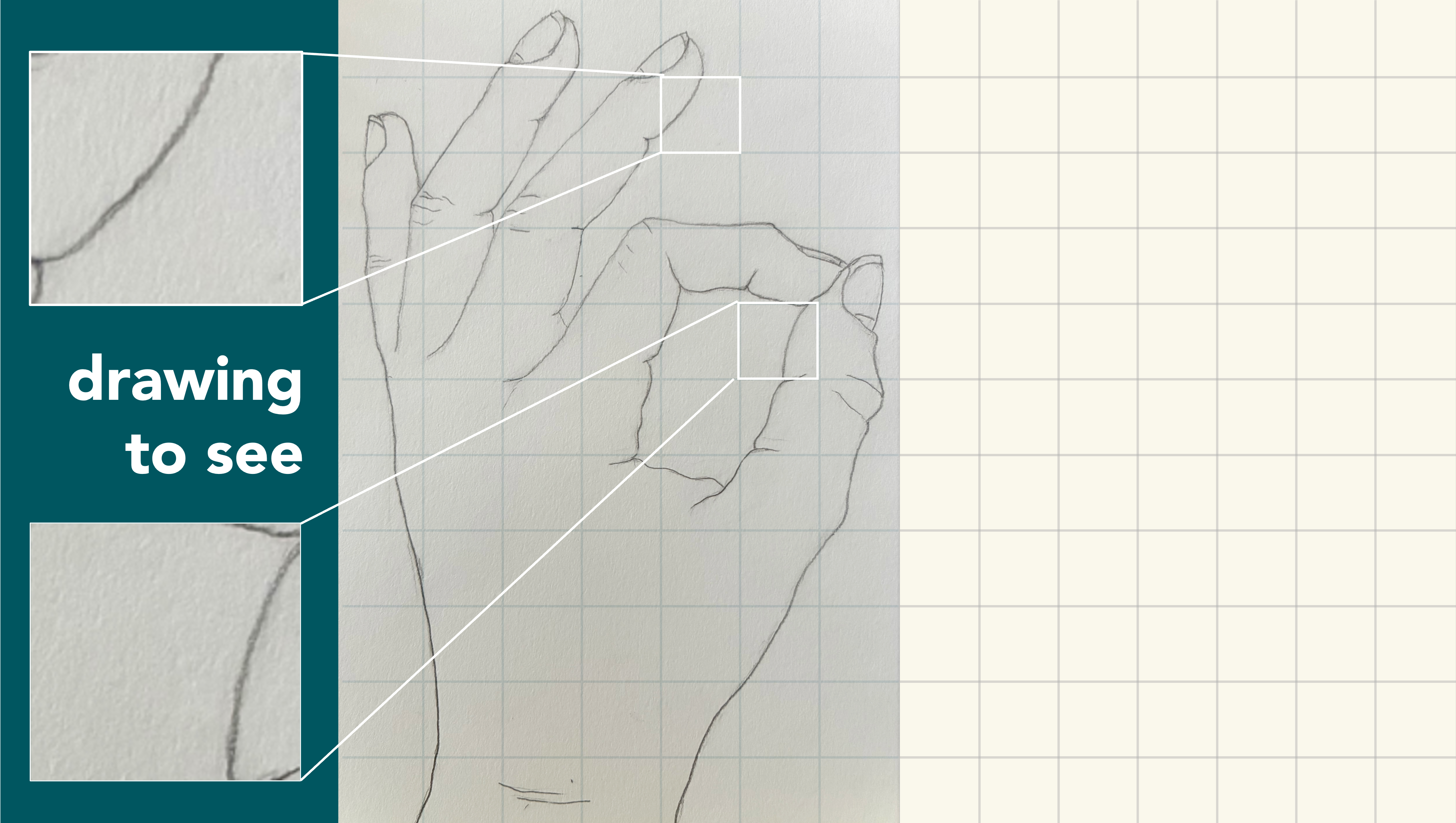
Here is printable PDF for anyone who’d like to give it a try.

Then, as they get more comfortable, I would encourage them to practice drawing their own hands without the grid. Or anything really, but hands are always available. With enough practice, they’ll start to look at the world like an artist does, with eyes hungry for previously overlooked details. What if they looked at data in that same way? Their improved drawing skills might also be used on a napkin to explain the ideas that artistically scrutinized data sparked to a colleague or collaborator. That’s science communication too.
Building creativity through metaphors
The process of coming up with metaphors for one’s work is a creativity booster. Asking a chatbot for one does not give the same benefit. It’s also a way to bridge the gap between scientists and non-scientists. But as I’ve said before, no metaphor is perfect, and finding the holes in them can open new channels of thought, leading to unexpected insights, sparking new experiments. Artists can help guide these creative conversations and even turn them into artworks.
Questioning assumptions through animation
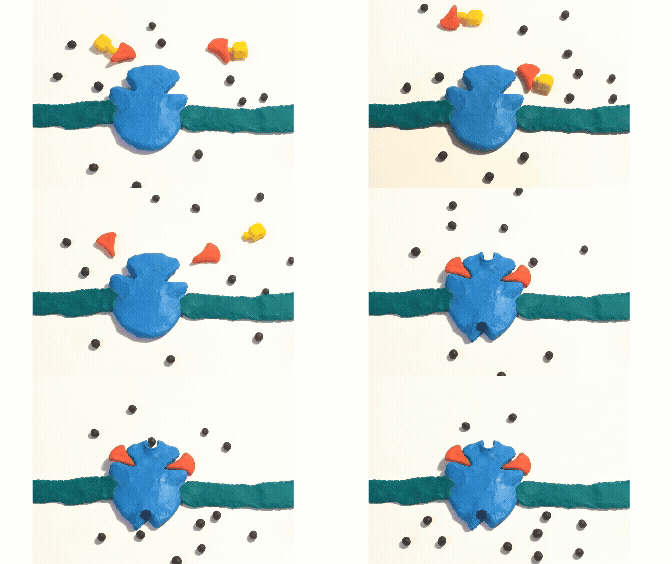
Animation is a powerful way to question assumptions because it demands to know how. Molecular animator Janet Iwasa has been making art with scientists for decades for just this purpose and she’s always been a huge inspiration to me. But there can be a large barrier to entry for animation, both in skill and money. Not so with stop-motion, which can be accomplished with a free, easy-to-use app and no artistic talent. The example below, made with clay and my phone, is purposefully simple and low-budget to illustrate my point. And the process of making these, again, can raise new questions and ideas for experiments. If the model checks out, the stop-motion animation could be handed off as a prototype to a professional 3D animator.
Who will pay for it?
Until more people see the value of this kind of work, getting paid to partner with scientists in this way will remain a challenge. But I wonder how people are using the broader impact requirements of many grants, which urge scientists to engage in meaningful outreach. Could these partially fund artists-in-residence? Many places, like the Broad Institute, already have such residencies. What if some looked like this?
There are departments, like Boston College’s Chemistry Department, that offer a science communication course. I would encourage more to do so and to hire working science communicators to teach them. Even better, maybe someday we will see more academic appointments like Janet Iwasa’s. She is an Assistant Professor in the Biochemistry Department at the University of Utah, and her primary role is creating 3D animations with scientists.
Another idea is to have artists partner with artistically minded scientists within the labs to help lead these activities. I’m willing to bet that there is, on average, at least one artist per lab, whether visual, musical, poetic, or otherwise. Probably more. I have heard of so many researchers hiding this side of themselves for fear of not being seen as serious scientists. But what if empowering them as art ambassadors created cultural change from within? And how many more artists might stay in science if they were given an outlet like this?
When I knew that our Ireland adventure would include a few days in Galway, I started poking around the University of Galway’s website. I discovered that it recently launched an Institute for Creativity, which reaches across the university and beyond to find opportunities for interdisciplinary engagement (which I belabor here all the time as the recipe for innovation). I’ve connected with one of the institute’s leaders and we have plans to talk soon, so stay tuned for more about that. For now, I will leave you with this excerpt from the institute’s website:
“The Irish government has established Creative Ireland, an agency dedicated to linking creativity, community, and well-being for all its citizens. Its Minister for Arts recently launched a pilot basic income scheme for the arts, providing professional artists with a guaranteed income.”
Imagine that.
Yay for a stop-motion shoutout!
Hi Mary's Substack,
OOnderful newsletter!
Great personal narrative (Irish Island Flight Path Hiccups a risk in support of Creative Ireland)!
Love to subtitles becoming titles, evolve and expand! Apply experiment with the human self, as you say, "no metaphor is perfect, and finding the holes in them can open new channels of thought, leading to unexpected insights, sparking new experiments."
Visualizations explains how we can imagine the unperceived self. Your metaphor, visual, can be a signal without the cognitive bias of known sight experience. Almost like the birth of a new relationship with self-awareness.
Check out my brief theoretical about visionaries: https://www.linkedin.com/posts/thriveondesign_science-magazine-the-real-da-vinci-code-activity-7418158891089408001-1Ns2
I hope you are well. I so appreciate you showing up to help raise ethics in the science communication space.
Be well. Stay active. HEART to the MOTION of visual understanding!