
Noticing makes us better scientists, while synchronicity makes us human
And how a dedicated drawing practice can help

Dear readers,
You know how I always call myself a magpie, collecting treasures eerily relevant to each month’s post as if the universe left them at my feet? I was listening to an interview with writer Meghan O’Rourke on Night Science, a fantastic podcast about creativity in science (highly recommend). She described feeling almost like a magnet when she’s deep in a project, “attracting all these little filings from the world, these little bits of metal, everything suddenly starts to seem connected to the project.” Well, this sent me down a rabbit hole. Want to come down with me for a minute?
I am fascinated by coincidences. I collect them like dead butterflies pinned to a Google Doc. My favorite one came after I’d just published an essay in the Boston Globe Magazine about my Mom’s genetic genealogy sleuthing that helped us solve the mystery of my paternal grandmother, who disappeared when my Dad was a baby. I brought the magazine home from the newsstand and had it open to my essay on the kitchen counter. While I made lunch, I silently wished that the universe could give me a sign that my late Dad would have been okay with me publishing it. It wasn’t my story to tell, after all. Thirty seconds later, my husband breezed by, glanced at the magazine, and said, “Oh, it’s right by the crossword puzzle. Your Dad would have loved that.”
Digging into the neuroscience of coincidences led me to a part of our brains I’d never heard of, called the reticular activating system (RAS), first described in 1949 from studies on cats.1 The RAS is believed to filter what we take notice of from all of the available sensory input, defining the signal from the noise. It is believed that chemicals in the brainstem either boost the signal, suppress the noise, or possibly both.2
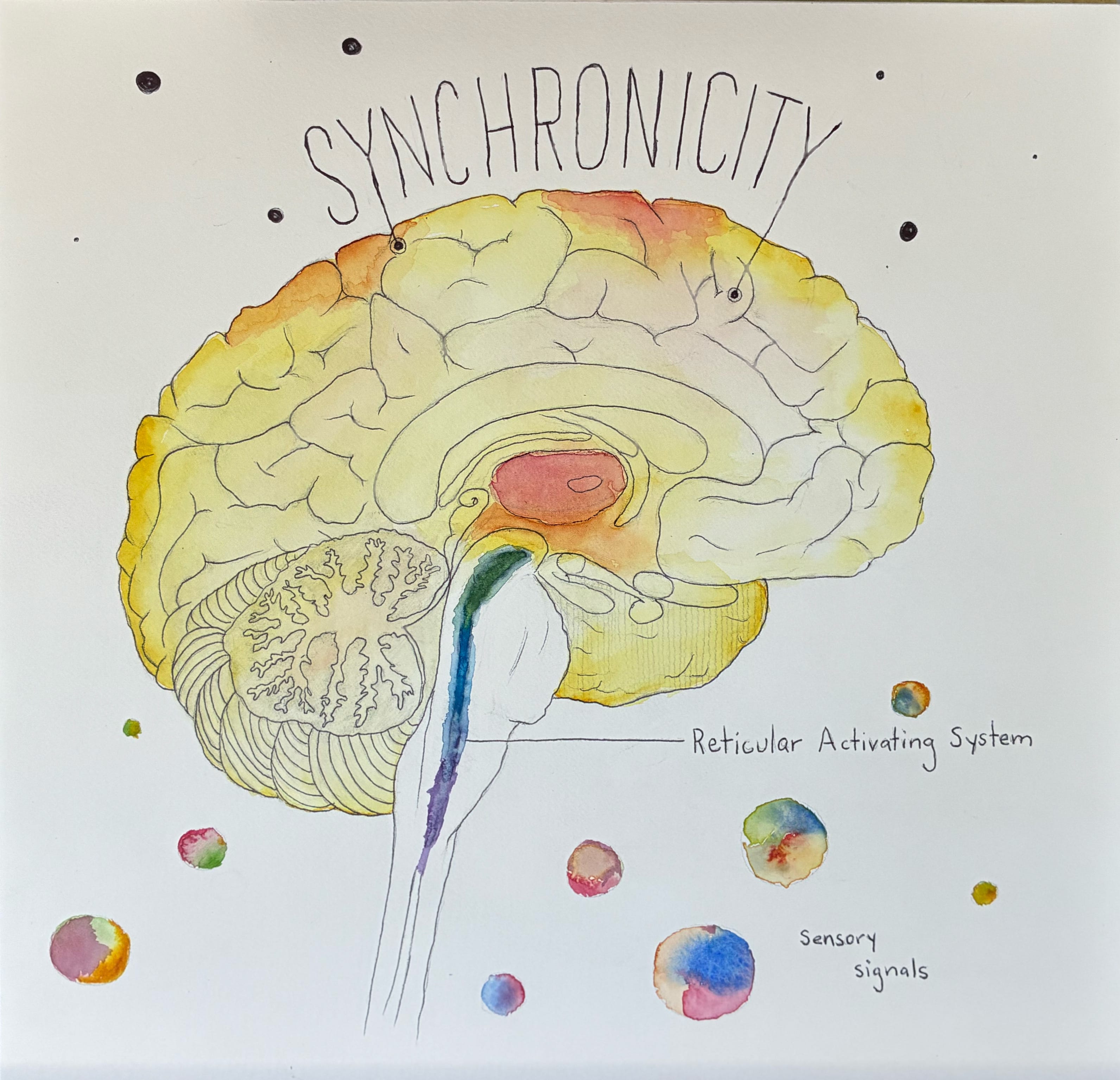
What really interests me is how what the RAS lets through tells us about who we are. When I’m out to eat with my friend of three decades, Shelby, an assistant principal of a junior-senior high school in our hometown, I can tell by a sudden tension in her brow that she’s just noticed someone, often many tables over, behaving badly. Not spit balls per se, but usually a more insidious kind of rudeness from an adult.
Before the RAS was discovered, Carl Jung had developed a theory he coined synchronicity to explain coincidences like the one I experienced over the essay. It was based in part on dynamic Einsteinian notions of space and time, and, I was amazed to discover, developed in close collaboration with his former patient, physicist Wolfgang Pauli3 of the Pauli Exclusion Principle, which many of us learned in general chemistry.4 Together, they defined these synchronicities as acausally linked, but meaningful occurrences, by which I think they meant meaningful to the person who notices them. And so maybe these metal filings, these treasures, are pulled through the RAS by the magnet of what we’re thinking a lot about, because it feels meaningful to us.
As scientists, we are at risk of subconsciously filtering out any information that doesn’t agree with the meaning we’ve made out of our data, and coincidences just reinforce this effect. In the debate over where AI and humans fit into the future of science, it is often pointed out that scientists suffer from this confirmation bias, while AI does not. The first tool to combat confirmation bias is self-awareness, but I’d like to propose that a dedicated drawing practice could help further. Stay with me.
In my senior year of high school, dreaming of art school, I walked through the world looking at everything as though I was going to draw it. I analyzed angles, shadows, and perspective. Processing all of that visual input was as exhausting as it sounds, and to be honest, I felt a small amount of relief after deciding to go study chemistry. But lately I’ve been trying to look that way more. It makes me feel oddly present, and I realize how much I’ve been missing while living up in my head. As I always say, a drawing practice is so much more about the process than the product, which is why the fact that AI can make art is cute but useless for our purposes. A regular drawing practice is a way to open the aperture and expand our sensory input to what we are missing, and that’s crucial in science, in looking at data. It is especially true if we stay open to the details we don’t want to see, because they may be the most important.
But we simply couldn’t function if we let everything in, and maybe our selective noticing actually gives us an edge over AI, because when it leads to synchronicity, we can find meaning in it. Not just patterns, but important flashes of insight, as long as we’ve addressed confirmation bias. And maybe it is something that makes us uniquely human. For what it’s worth, Google Gemini agreed that AI cannot experience synchronicity, and explained why, including that “a computer can identify statistical correlations or cross-reference data points, but it cannot experience the ‘aha!’ moment or the emotional weight of meaning. Meaning is an artifact of consciousness, not data processing.”
Here’s an example of synchronicity’s human benefits. It is possible that I married my husband in part because of a coincidence. Our personality types are in such diametric opposition that ol’ Meyers and Briggs put a warning label on their romantic pairing, and I knew it. However, despite having very different upbringings a thousand miles apart, both of our Moms took us to Red Lobster for good report cards when we were growing up. Certainly, I thought, this must be fate. A sign from the universe, not to be ignored. Or, did I clock this easily dismissed fun fact because some part of my psyche knew what I didn’t yet: that we would spend a lifetime uncovering layers of compatibility that run much deeper and truer than where we derive energy or how we make decisions. Or, maybe it was simple confirmation bias, which, in this case, led to the right outcome.
And while I love the thought of the universe delivering my Dad’s blessing on my essay, it might be more accurate to say that the selective listening5 I applied to my husband’s comment was just telling me what I already unconsciously knew to be true. That he would absolutely have been okay with it. Maybe even proud.
Coda:
An iron filing nearly knocked me over this morning. Walking the dog, I bumped into a neuroscientist friend that I haven’t seen in ages, right around the corner from our house. After we caught up, she started heading the other direction to continue her walk, then turned back to say, “Serendipity!” So I told her that I was actually writing about serendipity today, and how meta that was. And then she added, apropos of nothing, that she was really enjoying her noise-canceling headphones, which block out all other sensory input (her words) so she could fully focus on her podcast while she walked. Stop it, I said, I’m also writing about the reticular activating system. And there on the sidewalk, two women of science, fully aware of the physiological mechanisms at play, got the chills.
Taran, S., Gros, P., Gofton, T., Boyd, G., Briard, J.N., Chassé, M., Singh, J.M. The reticular activating system: a narrative review of discovery, evolving understanding, and relevance to current formulations of brain death. Can J Anaesth 2023, 70(4), 788–795.
Dietrich, A., Audiffren, M. Neuroscience & Biobehavioral Reviews, 2011, 35(6), 1305-1325
Paul Halpern, The Synchronicity of Wolfgang Pauli and Carl Jung, Nautilus Magazine, November 18, 2020
In case you didn’t, it’s basically but not really like the electron equivalent of how a person wouldn’t use a urinal right next to an occupied one if others are available.
Anyone who has been partnered long enough with someone will recognize this controversial function of the reticular activating system.
I never heard of the RAS (well, if I did, it was Psych 1 in 1972). Wonderful! I'll nurture those positive associations!
Your post reminds me of a quote from A River Runs Through It:
"All there is to thinking...is seeing something noticeable which makes you see something you weren't noticing which makes you see something that isn't even visible."
Norman Maclean is talking about fly fishing, but the same could be said about science.