
Where do ideas come from?
I'm honestly asking

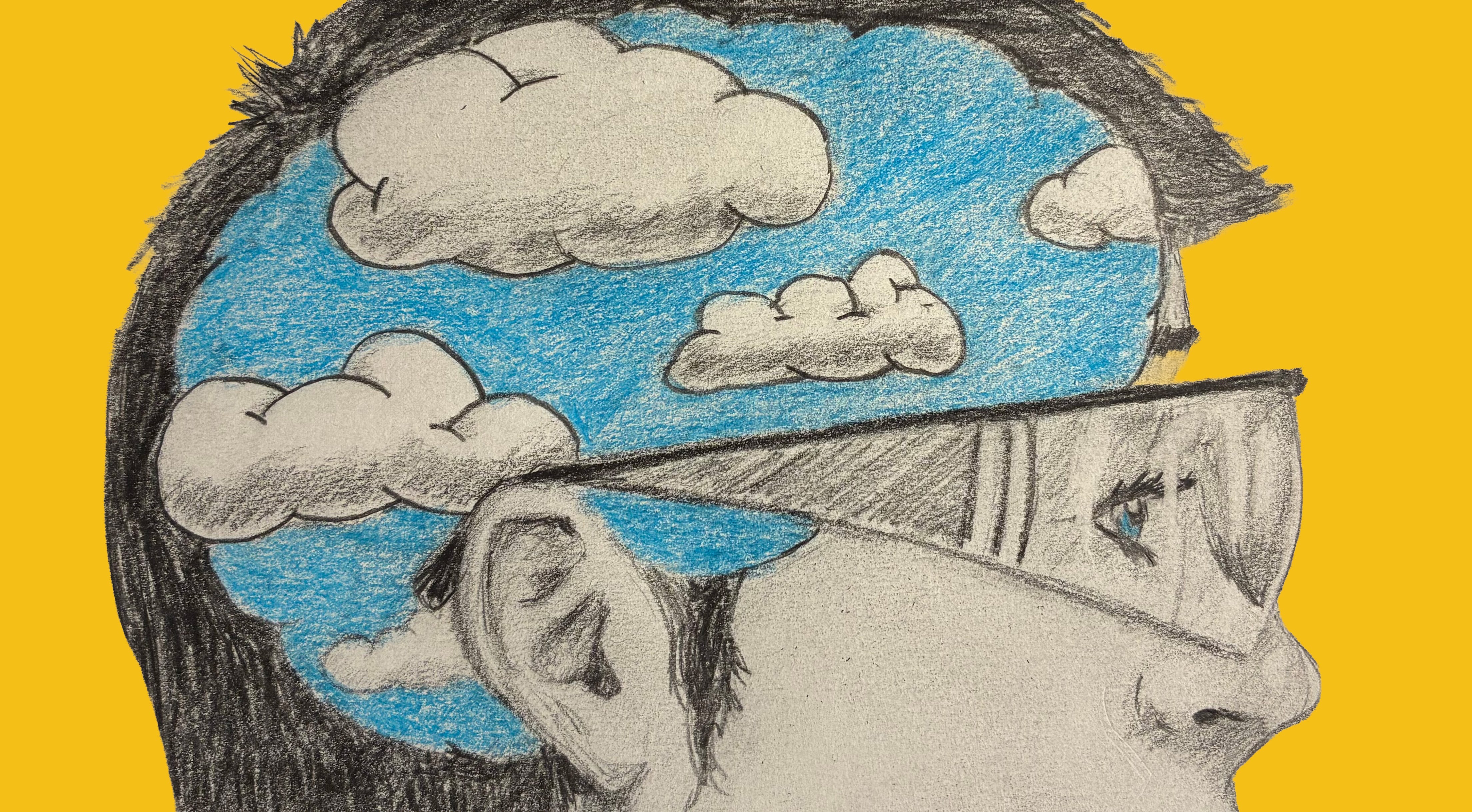
“We’re drowning in an ocean, or a sea of data, but we are starved from knowledge.”
—Nobel Laureate Syndey Brenner
It has been over twenty years since Brenner said this in his Nobel acceptance speech, but I think it still rings true. Are we really doing everything we can with the information we have?
Inspired by a single bullet point from the aspirational job posting I wrote last month, I became mildly obsessed with a pilot study to address this rhetorical paradox. It would be based on the hypothesis that if scientists were given activities to promote mind wandering at work, they would produce more ideas and overcome barriers more quickly. Cognitive scientists call it “the shower effect”, and fMRI imaging has localized it to regions of the brain called the default mode network (DMN). The DMN is suppressed when we’re engaged with external stimuli that require our conscious attention, but not suppressed while doing things with the cognitive demand of, say, showering. And that’s when the magic happens.
I’ve indoctrinated our kids with the value of the shower effect. If they’re struggling with a math problem, I don’t always help them right away. Rather, I tell them to do their best, then take a break and think about it again when they’re in the shower. The struggle is crucial for priming the brain for the flash of insight later. I mean, I’m not a monster; sometimes I just help them. But on more than one occasion, I’ve heard them yell from the bathroom, “Oh! I got it!”
That’s why I wanted to bring opportunities to access this state of mind into scientific spaces, where no parent can help researchers get to the answer because no one knows the answer yet. It’s their job to find it. And by “it” I don’t necessarily mean a eureka moment. Sometimes it’s just a small nudge that gets them past a blockage in thinking. It might be a question to look up, or a quick experiment to try. For me, sometimes it’s just, like, search terms.
You might ask, if you’re stuck on something, why not just read a research paper? You absolutely should! (In fact, my mind wanders all the time when I read papers, so maybe there’s a two-fer there.) But mind wandering might help you pinpoint exactly which vein to mine in the literature. And sometimes you have all the information you need, and it just needs to line up and click into place. Then the solution or idea falls into your head fully formed, like a gumball. And do you know what else happens? That clarity makes it easier to explain it to someone else, which I think we should all by now see is not a nice-to-have but a literal life-or-death necessity.
But there has to be a way other than showering at work to engage the automatic idea dispensers in our heads. What else promotes mind-wandering? That’s where the wall mural came in. I thought that if I created the outline of a mural, employees could come and spend thirty minutes or so mindlessly painting it. I would use a paint-by-number system to eliminate any decision-making that might prevent mind wandering. I would design these walls for many different workplaces and collect information. There would be rules, like no headphones, and people would work alone because small talk would inhibit the desired effect. There would be a QR code on the wall to complete a survey at the end of each painting session about their state of mind and whether they had any flashes of clarity or insight or the sudden arrival of ideas as if out of nowhere. I would install these for no more than the cost of the materials, because once I collected these surveys, the value of the walls would be so obvious that people would line up to commission them for their own spaces. I built a slide deck of my proposal. I designed a mandala in the shape of a human commensal virus. But, as I began gathering evidence to back up my claims, my story didn’t quite check out.
Turns out there is research on the effects of coloring on the brain. It was actually shown to induce a state of “flow”.1 Unlike mind wandering, which kicks in when we’re engaged in external stimuli that do not require our conscious attention, flow happens in the sweet spot of doing something that is just challenging enough, but not very challenging at all. And, it has been shown to correlate with suppression of the DMN.2 Even though this is the opposite of what I was after, I’m not knocking flow. The same study that showed flow and the DMN to be at odds suggests that flow is linked to increased creativity. As a bonus, it is widely credited with mental health benefits.3 Excessive mind wandering, on the other hand, has been associated with rumination and depression, so beware of that. But I’m still fascinated by it as a portal to ideas. But a portal from where? I think maybe ideas are generated from the combination of existing memories that hadn’t met each other before. But sometimes it feels downright spooky.
It often happens that once I start thinking about an idea for this newsletter, I start seeing it everywhere. This time, it was in three books and a TV series. In The Stormlight Archive book series by Brandon Sanderson,4 there is a realm called Shadesmar—another dimension also known as the cognitive realm, where ideas live. It is described as a reflection of the mind, a complete inversion. And because we finally got around to watching the first two seasons of Stranger Things, I saw a similar parallel dimension in what the characters call “The Upside-Down”. And then, in The Alchemist by Paolo Coelho, he refers to accessing special knowledge from some other dimension as “piercing the soul of the world”. Elizabeth Gilbert has her own theory about where ideas come from in her book Big Magic. For her, they aren’t formed in the brain but rather circulate in the world, inhabiting anyone who might have the fortitude to see them all the way through, moving on to someone else if they don’t.
The most reliable place I’ve found to consistently achieve that clarity of thought and the expansive dreaminess that welcomes ideas from wherever they live was in the kids’ rooms at bedtime. The darkness, cozy warmth, and white noise mingling with their deepening breathing created the perfect environment. So I was fascinated by the Stranger Things character Eleven accessing “the Upside-Down” through sensory deprivation—blindfolded and dunked in a float tank. This is obviously fantasy and I know it sounds a little woo-woo for a newsletter about science, but then again, I don’t know anything that seems more woo-woo to me than quantum entanglement, so I say all bets are off. What is spookier than the brain and consciousness? Brandon Sanderson even seems to draw on quantum physics for his fantasy world-building, where observation, or measurement, creates reality.
I noticed that as Eleven got better at accessing the Upside Down, she needed less and less sensory deprivation. It weirdly gave me hope, since our kids aren’t little anymore, that maybe whatever we use to pierce the soul of the world is a muscle that we can strengthen. Again, I know, this is fiction. But as Lord Byron said in his 19th-century poem, Don Juan:
“’Tis strange—but true; for truth is always strange; Stranger than fiction: if it could be told, How much would novels gain by the exchange! How differently the world would men behold!”
So, where does this leave my murals? I’ll have to think about how flow fits into scientific inquiry. I’m not as personally familiar with it as I am with mind wandering, but I know I’ve experienced flow as much while mining sparkly literature veins as I have while painting.
For now, I am afraid that my best advice for getting ideas at work would be extremely unpopular. It would be to leave your headphones at home. To do the tedious things without distraction, letting your mind roam. But honestly, I don’t even have much conviction in that advice because accessing this state will be different for different people. Sometimes my mind wanders when I listen to a podcast that doesn’t hold my interest. Exactly how bored by it do I need to be? Who knows! My husband uses a systematic framework that works for him and doesn’t require mind wandering at all. And I certainly don’t mean to suggest that talking to other people isn’t a wonderful way to generate new ideas. Maybe my best advice after all is just to notice when the magic happens for you, note what you were doing, and, well, do that whenever you need an idea. I’d love to hear what works for you.
Hang, Y., et al. Sensors 2024, 24(6), 1894; Chen, H., et al. Front Psychol. 2024 14, 1301531. Caveat: I am not a neuroscientist and quite limited in how critically I can read this literature.
Front Behav Neurosci. 2026 19, 1690499.
I am reminded of a tough day one of our kids had in preschool. Because it was a Montessori preschool, his teacher let him choose what he needed, and he chose to wash the windows. He spent hours with a squirt bottle and rags. I suspect he entered a flow state that centered him and calmed his nervous system.
I started reading these when our 11-year-old asked for Book 2 of this series and I found it in the adult section of the library. He has a voracious appetite for fantasy books of increasing complexity, and I think I deserve a medal for trying to keep up with him because not only is he a much faster reader than I am, the first book alone is over 1,200 words.
I really enjoyed this piece Mary! I like all the different arguments you present, and I think it probably also changes for each person and in each chapter of life for how they best get their ideas. For me in this chapter of my life, my ideas flow best at bed time. Right after I've stretched and turned off the lights. I lie down and have some really great reflections.
Pure magic, Mary. You constantly amaze me. This one bears rereading, more than a once.